
Are you looking for hidden gems in Belgrade? Discover three elegant interiors that belonged to three Serbian historic figures that devoted their lives to the study of Balkan characters. These talented men made us know ourselves better, introduced us to the world and brought the world to us.
Visit the homes of the geographer Jovan Cvijić, writer Ivo Andrić and artist Paja Jovanović, to combine the pleasure of discovering hidden gems in Belgrade with getting to understand Serbian and Balkan mentality and culture.

#1 Hidden Gem in Belgrade – Authentic 1905 Belgrade Home of the Scientist Who Negotiated Serbian Borders
Start with the original home of the scientist Jovan Cvijić, located in the atmospheric quarter called Kopitareva Gradina. The neighborhood was developed in the first decade of 20th century and is still quite untouched.
Jovan Cvijić (1865 – 1927) was the pioneer of geography and ethnology in Serbia. He was twice elected the head of the Royal Academy and Belgrade University. His geographic and ethnographic maps were used to draw the official borders of the new Yugoslav state at the end of WWI.
The devoted explorer spent 40 years in the field. He would simply walk for tens of miles or ride a little horse.
Cvijić’s explorations of the Earth made him conclude that “all truths are temporary”. One of my favorite quotes to resort to.
Some 10 years ago, reading Cvijić’s study on Balkan psychological types, I was amazed to recognize myself in one of the types! You can hear about the Balkan psychological types on a private tour, in the perfect setting of the author’s home decorated with unmistakably Balkan patterns.
The decoration of the house built for Cvijić in 1905 was done by his friend, the pioneer of decorative arts in Serbia, Dragutin Inkiostri Medenjak. Its custom-made combination of traditional local styles with art nouveau is aesthetically intriguing and illustrative of the spirit of Belgrade. Always melting and balancing between the East and the West.
Notice the al secco decoration of the walls and ceilings. The eagle carrying a geologist’s hammer over a sphere symbolizes the house-owner’s profession and his grasp.
The custom furniture designed by Medenjak was upholstered in the ethnic hand-woven materials Cvijić brought from his field explorations in the Balkans.
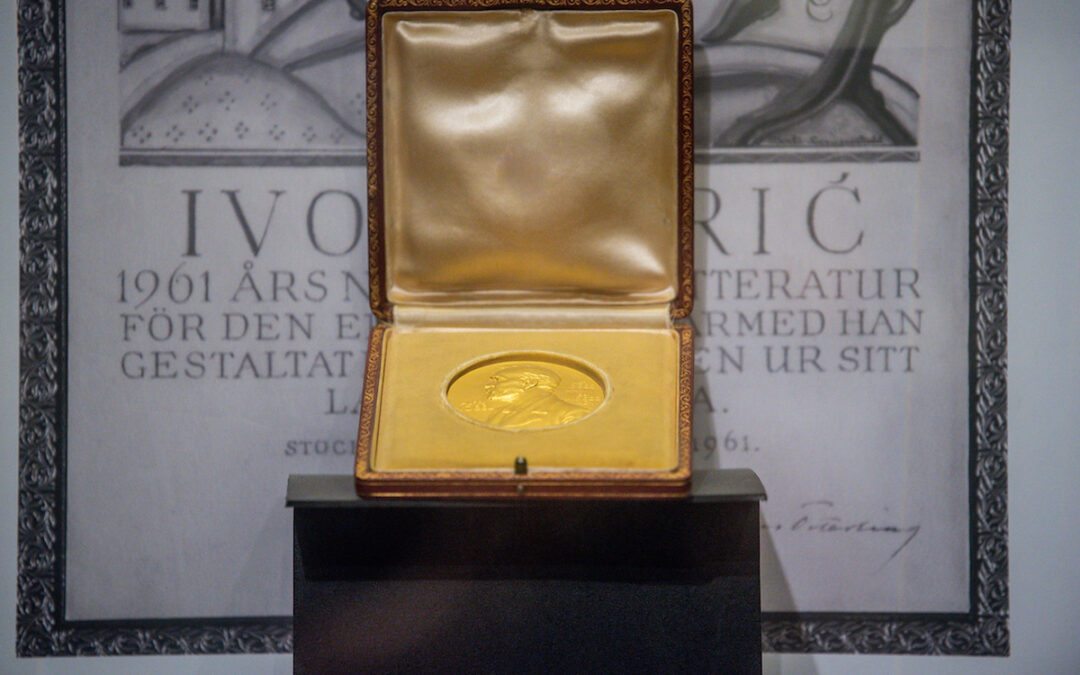
#2 Hidden Gem in Belgrade – Nobel Prize Medal and Diploma
After grasping the geography of Serbia at Cvijić’s home, call on another authority on the Balkan region and its psychological types.
Ivo Andrić (1892 – 1975), a Bosnian-born writer and a royal Yugoslavian diplomat, received the Nobel prize for literature in 1961. His apartment that shares the address with the seat of the President of Serbia (once a Royal Court) is elegant and a bit austere. As was the author himself.

This is the perfect setting to hear about the subject matter of Andrić’s novels and see his Nobel diploma. Awarded in 1961, for Andrić’s writing on the pre-Yugoslav history in the Balkans, this Nobel prize was an important political signal.
Our private tour includes a commentary on Yugoslavia in the Cold War Era, as relevant for this Nobel prize as was the undisputed artistry of Andrić as a writer.
Andrić lived in the apartment from 1958 until his death in 1975. He lived with his wife, a theatre costume-designer Milica Babić, a lady whom he had been in love with years before they married, and with his mother-in-law.
#3 Hidden Gem in Belgrade – Artist’s Studio from 1890s
To complete the exploration of Balkan minds through the eyes of those who studied them, visit the Legacy Museum of Paja Jovanović, in Kralja Milana Street.

Paja Jovanović (1859 – 1957) was a prolific artist. His works have been reaching their all time highs at world auction houses in recent years.
This is caused by the growing interest of Arab collectors for the so called Orientalists. At the end of the 19th and during the first decades of the 20th century, the Orientalists depicted genre scenes from cultures influenced by Middle East traditions, flowing across the Ottoman Empire. Being an avid researcher of Balkan landscapes, houses, rituals and costumes, Jovanović was already enjoying the benefits of the art market’s taste before the age of 30. Back then, the demand for the Orientalists was coming from England and US.
You can feel the artist’s cosmopolitan spirit at his Museum in Belgrade, in the setting of his original 1890s Viennese studio perfectly reinstated in a Belgrade apartment from the 1930s. Here you can see the paintings that show why the high society of Austria, Serbia and Yugoslavia wanted their portraits painted by no-one else but Paja Jovanović. Other important exhibits include a glorious historical composition from Serbian Medieval past exhibited at 1889 World Fair in Paris and a beautiful triptych of portraits of the artist’s young wife Muni.
If you’re an art lover visiting Belgrade, you may also want to explore the Orthodox Icons in Belgrade or hop galleries to discover Belgrade contemporary art.
Ksenija, the author of this blog, is an art historian and a licensed tour guide. Have a quick glance of 8 private guided tours of Belgrade that Ksenija curated around the cultural phenomena unique to the Serbian capital.