
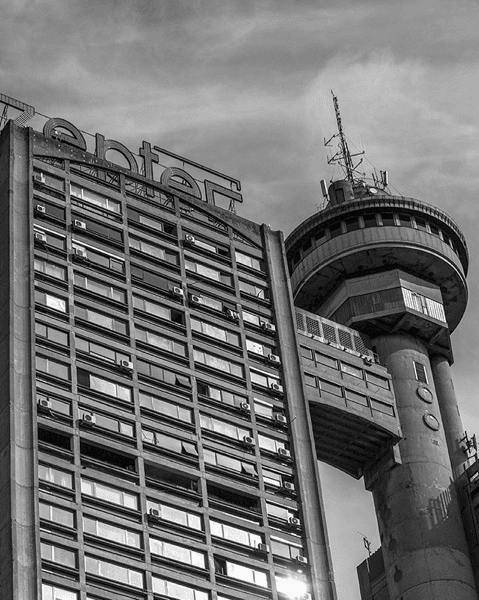
The socialist and brutalist architecture in Belgrade has received its fair share of attention in the last ten years.
New York’s Museum of Modern Art acknowledged the social and aesthetic merits of the architecture of Socialist Yugoslavia with its 2018 exhibition Toward a Concrete Utopia: Architecture in Yugoslavia 1948 – 1980. Travellers are visiting New Belgrade for its modernist and brutalist architecture, while the social media accounts celebrate these buildings for their “insta-worthy” aesthetic.
In this post, we’re bringing you the lesser-known stories of three iconic buildings in New Belgrade: Genex Tower, Block 23 and Sava Centre. These are the stories you don’t expect from communist landmarks.
Find out about a wildly successful communist multinational company, the apartment space planning method invented by Belgrade architects and how a gigantic congress centre was first sketched on a plane.
Genex Tower: The Brutalist Icon
This brutalist building has achieved iconic status among Belgrade landmarks. Its Instagram videos are reaching millions of viewers, the photographers love shooting it, the local designers make T-shirts, posters and miniature sculptures after it. Genex Tower is also the third stop of our Brutalist Tour of Belgrade architecture.
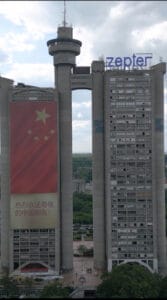
This piece of Belgrade brutalist architecture was built in the years from 1970 to 1980. Although it wasn’t the initial plan, the foreign trade company called Generalexport, short Genex, became the building’s owner. Genex had its offices in one tower and the apartments for its employees in the other.
The company itself was impressive. Founded in 1952 by the Serbian Government, the company had grown to a several billion dollar business in the 1980s.
Its success was enabled by Communist Yugoslavia’s independence from both Cold War blocs. Genex was able to do business with both Eastern and Western Blocs, who couldn’t trade directly between themselves. It was buying raw materials from the USSR and selling them to Yugoslavia and Western countries, while importing finished products from the West.
Genex was the company that brought Coca Cola and McDonald’s to Socialist Yugoslavia.
It had subsidiaries in Frankfurt, Milan, New York, Stockholm, Beirut, Moscow, Prague and Berlin and diversified from foreign trade into real estate, finance, air transport, retail and hospitality. By 1991, Genex had 5,000 employees. The company was connected with the Yugoslav Intelligence Service, as were all Socialist Yugoslav companies that were doing business internationally, but these ties remain confidential.
In the 1990s, with the end of the Cold War, the dissolution of both the USSR and Yugoslavia, and the international sanctions against Yugoslavia, Genex lost its market and power. After decades of struggle, the company went bankrupt.
The office tower of the building shared the destiny of the business. In the 21st century, it was leased, but was drastically losing its splendour without proper maintenance. Most of the offices remained vacant for years. In 2023, the office tower was sold to a private company for 20 million euros, not without controversy. It’s still vacant and crying for care and maintenance, but it remains one of the biggest symbols of socialist architecture in Belgrade.
Controversy Around Revolving Restaurant at Genex Tower
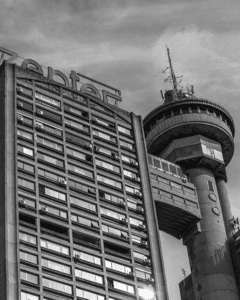
A prominent feature of the building is the cylinder-shaped tower on its top, with a restaurant inside. Many Belgraders believe the restaurant used to rotate, as it was intended to. In fact, it never had.
The architect of Genex Tower, late Professor Mihailo Mitrović, once told an interesting story of his inspiration for designing the revolving restaurant and why the rotation mechanism was never set in motion. Impressed with the rotating restaurant of Frankfurt’s Main Tower, the architect designed one for New Belgrade’s Genex Tower. Yet, the rotation mechanism was never installed.
The restaurant at the top of the Genex Tower was supposed to rotate, but that never happened. The company executives feared they would be judged for excess, measured by the society’s general communist standards.
They preferred the excessive to happen away from the public eye, so they kept the restaurant private. The invite-only restaurant was serving, among other things, a whiskey label Genex was importing, not available anywhere else in Yugoslavia. The guests were mainly high-ranking communist officials.
Apartments in Brutalist Blocks in New Belgrade – A Case Study in Space Planning
During the 1960s and 1970s, tens of thousands of people from all over Yugoslavia were moving to Belgrade for work. This influx increased the need for quick and efficient construction of housing blocks in New Belgrade. To that end, Yugoslav construction materials producers devised a technology of prefabricated concrete blocs.
The architects stood up to the challenge as well. They were designing apartments that were not large or expensive to build, as the socialist ethos and limited budgets didn’t allow for that, but that were functional and comfortable.
How did they manage?
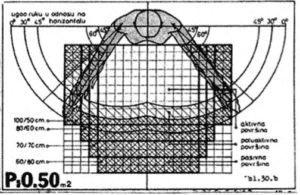
An institute undertook extensive scientific research on how people actually use apartments.
All the activities people typically perform in apartments were mapped and the space required measured, from eating and preparing meals to sleeping and lovemaking, for optimum space planning of the buildings.
The mannequins were used to model how much space people take up when using different rooms and in which ways. For instance, the researchers measured how a woman moves when reaching for kitchen cabinets and how she moves when cooking at the stove.
The typical interactions among family members were also mapped. Several scenarios were considered: families with one or two children, or whether a woman was working or not. The typical furniture dimensions were also considered. Everything was measured and mapped to ensure optimal functionality of the space.
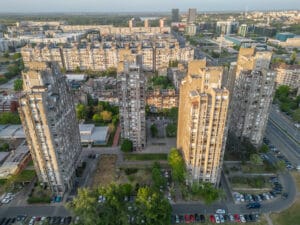
Belgraders who have been living in these apartments still praise their functionality, and many local home buyers insist on buying these icons of brutalism in Belgrade for that exact quality.
The most representative of these blocks is Block 23, the fourth stop of our Unorthodox Socialism Tour of Belgrade architecture.
Sava Center – Futuristic Colossus First Sketched on a Flight
With the softening of the Cold War, the era of dialogue between the two blocs began. The organisation founded with that mission, the Organisation for Security and Co-operation in Europe – OSCE, held its first conference in Helsinki in 1975. The role of the host city of the second OSCE conference in 1977 was awarded to Belgrade, Yugoslavia, the place that had its own history and politics of balancing between East and West.
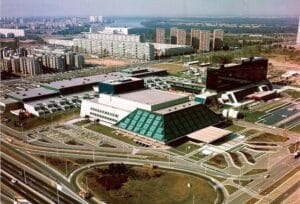
What Yugoslavia or Belgrade did not have was an appropriate congress hall. However, the Yugoslav Government was certain it could build one in time. The main architect was facing an impossible deadline, but without fuss, Stojan Maksimović simply boarded the next flight to Helsinki to see Alvar Aalto’s Finlandia hall, where the first conference took place.
Then Maksimović took flights to Paris and Copenhagen to see their large congress centres.
The first sketches of the now iconic Sava Center were made on a Finnair’s passenger satisfaction questionnaire, British Airways sickness bags and hotel room memo papers.
Within a month, the architect had the concept for what would become Yugoslav architectural heritage.
The construction was also completed at record speed, with 1,000 people at the site every day. The first 50,000 square meters were completed in 11 months. The next 30,000 square meters, which included the grandiose congress-concert hall with 4,000 seats, were rushed to be completed in 1978, to host the Communist Party Congress. A year later, the hotel was added, and the bankers replaced the communists at the World Bank and IMF annual meeting.
The building was intended to serve as proof that socialist Yugoslavia could match the highly developed countries.
Only 13 years later, in January 1990, the last Yugoslav Communist Party Congress, which initiated the dissolution of Yugoslavia, took place in the Sava Centre. The plaque at the entrance still keeps the words by the Yugoslav leader Tito, hoping this piece of communist architecture of Yugoslavia would “contribute to World Peace”.
Built to announce the super-modern era of Yugoslav Socialism and host the world, Sava Centre became the place where the collapse of Yugoslavia started, followed by the civil wars and international isolation during the 1990s.
Being the last great work of Yugoslav socialist architecture, Sava Center is the final stop of our Unorthodox Socialism Tour.
Ksenija Kastratović, the author of this text and the guide of the Unorthodox Socialism Tour of Belgrade architecture, lived her school years in New Belgrade in the 1980s and 1990s. You can imagine how her personal memories of New Belgrade complement her professional interest as an art historian in architecture. One of them takes us back to 1985, when together with a hundred students, Ksenija performed on the stage of Sava Centre, when their school, Branko Radičević, located in Block 45 since 1975, was celebrating its 100th anniversary.